You’ve probably heard the term ERP thrown around in business conversations. Maybe a consultant mentioned it. Maybe you saw it on a software vendor’s website. But what does it actually mean — and more importantly, do you need one?
Let’s break it down simply.
What Is ERP?
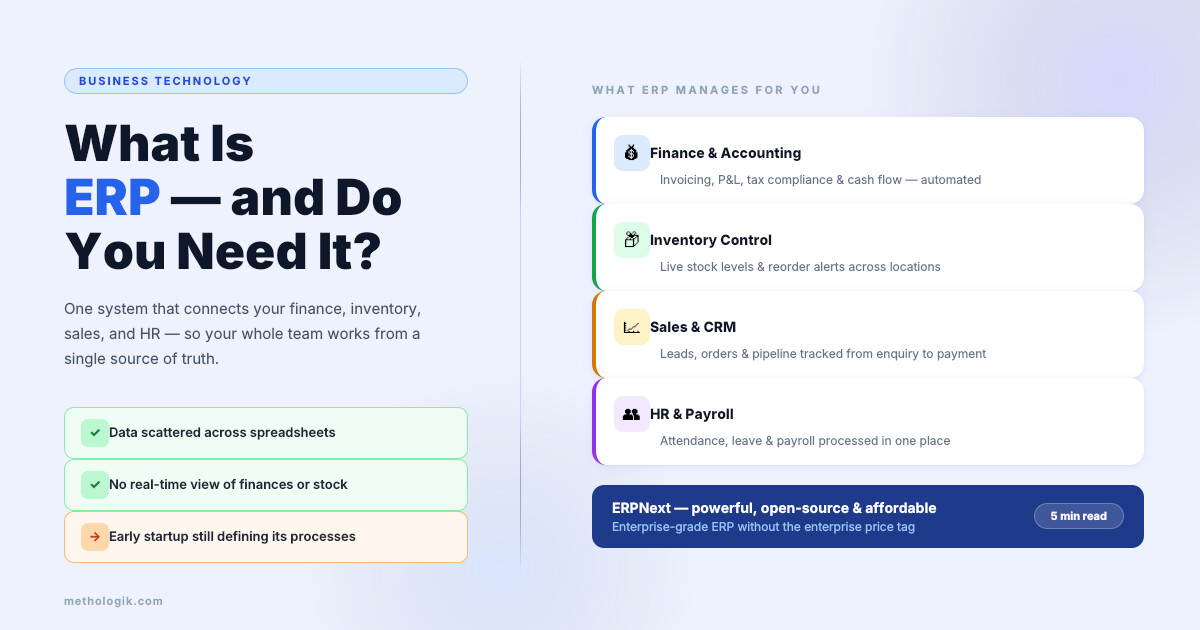
ERP stands for Enterprise Resource Planning. Strip away the jargon and it’s really just one thing: a single system that connects all the different parts of your business — accounting, inventory, sales, HR, purchasing — so they all talk to each other in real time.
Without ERP, most businesses run on a patchwork of disconnected tools. Your sales team uses one spreadsheet. Your accountant uses another. Your warehouse staff keeps a separate stock register. Nobody has the full picture, and by the time someone does, the data is already outdated.
ERP fixes that. One platform. One source of truth.
What Does ERP Actually Do?
Depending on what your business needs, an ERP system can manage:
Finance & Accounting — invoicing, expenses, profit & loss, tax compliance, and cash flow — all automated and real-time.
Inventory Management — know exactly what’s in stock, what’s running low, and what needs to be reordered, across multiple locations.
Sales & CRM — track leads, manage customer orders, monitor your sales pipeline from enquiry to payment.
HR & Payroll — employee records, attendance, leave management, and payroll processing in one place.
Purchasing — manage vendor relationships, purchase orders, and supplier payments without chasing emails.
Reporting & Analytics — instead of building reports manually, ERP generates them automatically, so you can make decisions based on real data.
Does Your Business Actually Need ERP?
Here’s an honest answer: not every business does — at least not yet.
You probably need ERP if:
- You’re managing operations across spreadsheets and things keep slipping through the cracks
- Your team wastes hours every week manually transferring data between systems
- You have no real-time visibility into your finances or stock
- You’re growing and your current tools can’t keep up
- You’re spending more time on admin than on the actual business
You probably don’t need ERP yet if:
- You’re a very early-stage startup with a small team and simple operations
- Your processes are still being defined and change frequently
- You can manage everything cleanly with one or two affordable tools
Open Source vs. Commercial ERP
There’s a common misconception that ERP is always expensive. It doesn’t have to be. Open-source platforms like ERPNext (now Frappe) offer powerful ERP capabilities at a fraction of the cost of SAP or Oracle — and they can be customised to fit your specific industry and workflows.
The right choice depends on your business size, budget, and how much customisation you need.
The Bottom Line
ERP isn’t just for large corporations. If your business has reached the point where managing multiple moving parts has become genuinely painful — whether that’s tracking inventory, closing your monthly accounts, or just knowing where your money is — an ERP system will save you far more than it costs.
The key is choosing the right one, implementing it properly, and not over-complicating it for your current scale.