Introduction
Walk into almost any small or medium business in Karachi, Lahore, Riyadh, or Jeddah today and you will find the same scene. A notebook on the counter. A WhatsApp group with staff. An Excel file someone made three years ago that no one fully understands anymore. A business owner whose entire operation lives in their head.
This is not a failure of ambition. These are often hardworking, profitable businesses — a car rental shop with 40 vehicles, a banquet hall booking weddings every weekend, a gym with 200 active members, a retail store processing hundreds of transactions daily.
The failure is informational. These businesses are flying blind.
And flying blind in business has a price — one that most owners never sit down to calculate because they are too busy putting out fires that a proper system would have prevented in the first place.
This article breaks down exactly what running without a management system costs, what the common objections are, and what actually changes when a business makes the switch.
What “Running Manually” Actually Means in 2026
When we say a business is running manually, we do not mean it has no technology at all. Most businesses today use some combination of:
- WhatsApp for customer communication, staff coordination, and order tracking
- Excel or Google Sheets for records, inventory, and basic accounting
- Paper registers or notebooks for daily transactions
- The owner’s memory for everything that does not fit anywhere else
- Basic accounting software that only handles invoices but nothing operational
This hybrid approach feels functional — until something breaks. And in every business, things break constantly.
A booking is double-confirmed. An inventory item goes missing with no record of where it went. A customer insists they paid and there is no clean record to check. A staff member leaves and takes institutional knowledge with them. The owner takes a day off and nothing moves because the entire operation depends on one person being present.
These are not rare events. They are the daily reality of businesses running without integrated systems.
The Real Cost — Breaking It Down
1. Revenue Lost to Missed or Mismanaged Bookings
For any service business — a car rental, a banquet hall, a clinic, a gym — bookings are the product. A missed booking, a double-booking, or a late confirmation is direct revenue loss.
Consider a banquet hall that books weddings at PKR 150,000 per event. If poor record-keeping causes even two booking conflicts per year — forcing refunds, offering discounts, or losing clients — that is PKR 300,000 in direct revenue loss. More damaging is the reputational cost. A wedding booking conflict does not just lose one client. It loses everyone that client tells about the experience.
A proper booking management system with a visual calendar, conflict alerts, and automated confirmations eliminates this category of loss entirely.
2. Cash Flow Damage from Untracked Dues
Outstanding payments are the silent killer of cash-flow-positive businesses. In almost every business running manually, there is a gap between what has been invoiced and what has actually been collected — and nobody knows exactly how large that gap is.
A car rental business with 17 active rentals and no systematic due tracking may have PKR 500,000 or more in outstanding payments with no structured follow-up process. A gym with 200 members where renewal reminders are sent manually via WhatsApp will inevitably have members whose subscriptions lapse unnoticed for weeks.
A management system surfaces every outstanding due, flags it automatically, and creates the follow-up record needed to collect it. Businesses that implement this consistently report collecting 20 to 40 percent more of their invoiced revenue simply because they now know what to ask for.
3. Inventory Shrinkage
For businesses with physical inventory — chairs, tables, and linens for a banquet hall; cameras and equipment for a rental business; medicines and supplies for a clinic; ingredients for a restaurant — untracked inventory is a constant drain.
Items go missing between events. Damage is not recorded against the right event. Reorder levels are missed because nobody knows how much stock is actually on hand. Suppliers are overpaid because purchases are not cross-referenced against deliveries.
Industry estimates for unmanaged inventory shrinkage in service businesses range from 3 to 8 percent of inventory value annually. For a banquet hall with PKR 5,000,000 in equipment, that is PKR 150,000 to PKR 400,000 disappearing every year — not through theft, but through the simple absence of a tracking system.
4. The Owner Dependency Problem
Perhaps the most expensive hidden cost of running manually is what happens when the owner is not there.
In a manually run business, the owner is the system. They know which customer has a pending payment. They know which vehicle is due for service. They know which staff member is assigned to which booking. When they travel, fall sick, or simply want to take a day off, the business slows down or stops.
This is not a management problem. It is a systems problem. A proper management system makes this information accessible to anyone with the right access level — freeing the owner to step back without the business stepping back with them.
5. Decisions Made on Gut Feel Instead of Data
A business owner who cannot answer the following questions in under two minutes is running blind:
- What was my revenue last month compared to the month before?
- Which product, service, or customer is most profitable?
- What is my current outstanding receivables total?
- Which days of the week or months of the year are slowest — and why?
- How much am I spending on operations versus what I am earning?
Without a management system, these questions require hours of manual calculation — which means they never get answered. Decisions get made on instinct instead.
A business running on data can spot a slow quarter coming two months early and respond. A business running on instinct discovers the slow quarter when the bank account runs low.
The Three Most Common Objections — and Why They Do Not Hold Up
“A system is too expensive for a business my size”
The math rarely works out this way. A management system that costs PKR 50,000 to set up and PKR 5,000 per month to maintain is a sound investment for any business doing PKR 500,000 or more in monthly revenue — which covers most small and medium businesses seriously considering this question.
The more accurate framing: the cost of the system is fixed and known. The cost of not having one is variable, hidden, and almost certainly larger.
“My business is not complicated enough to need software”
This objection usually comes from business owners who have never seen their operation reflected back to them in data. Every business that has made the switch says some version of the same thing after their first month: “I had no idea the numbers looked like this.”
A single-location gym with 200 members, six subscription tiers, a student discount programme, multiple payment methods, and monthly renewals is not a simple operation. It just feels simple when you are managing it informally — because the complexity is invisible rather than absent.
“I do not have time to learn a new system”
This is the most understandable objection and also the most self-defeating. The reason most business owners feel they have no time is because their current manual operation demands constant firefighting. The system is precisely what creates the time.
Most modern business management systems are designed for non-technical users. The learning curve for a well-built system is days, not months — and most good software providers offer onboarding support that flattens it further.
What Actually Changes When You Implement a System
The difference between a business running manually and a business running on a proper management system is not just operational efficiency. It is a fundamentally different kind of visibility — and visibility changes how decisions get made at every level.
Week one: Bookings stop conflicting. Every customer interaction has a record. Payments are tracked against invoices from the moment they are created.
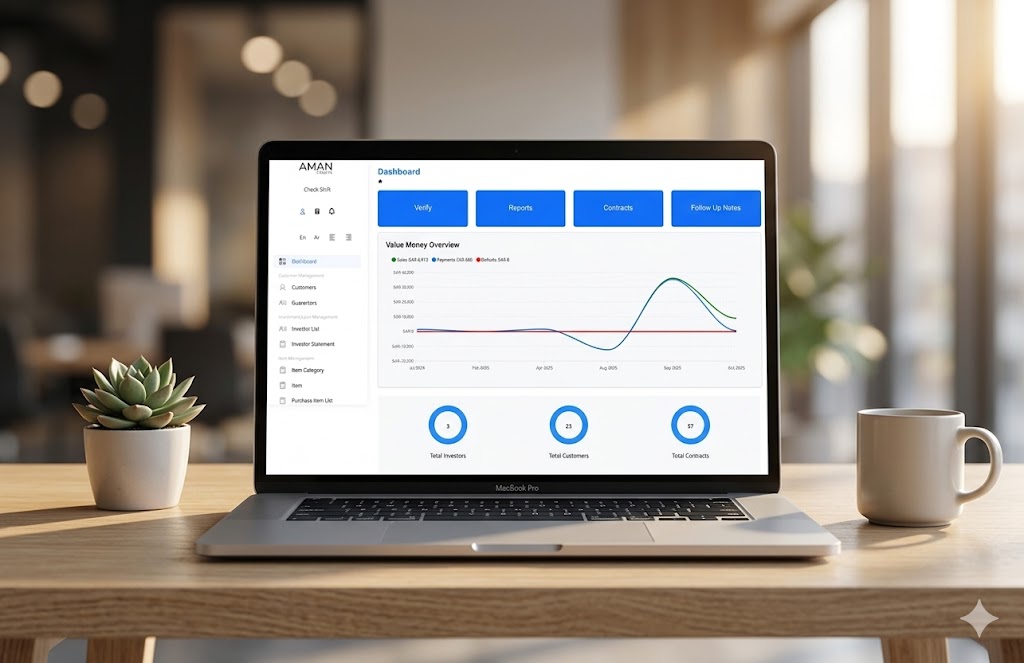
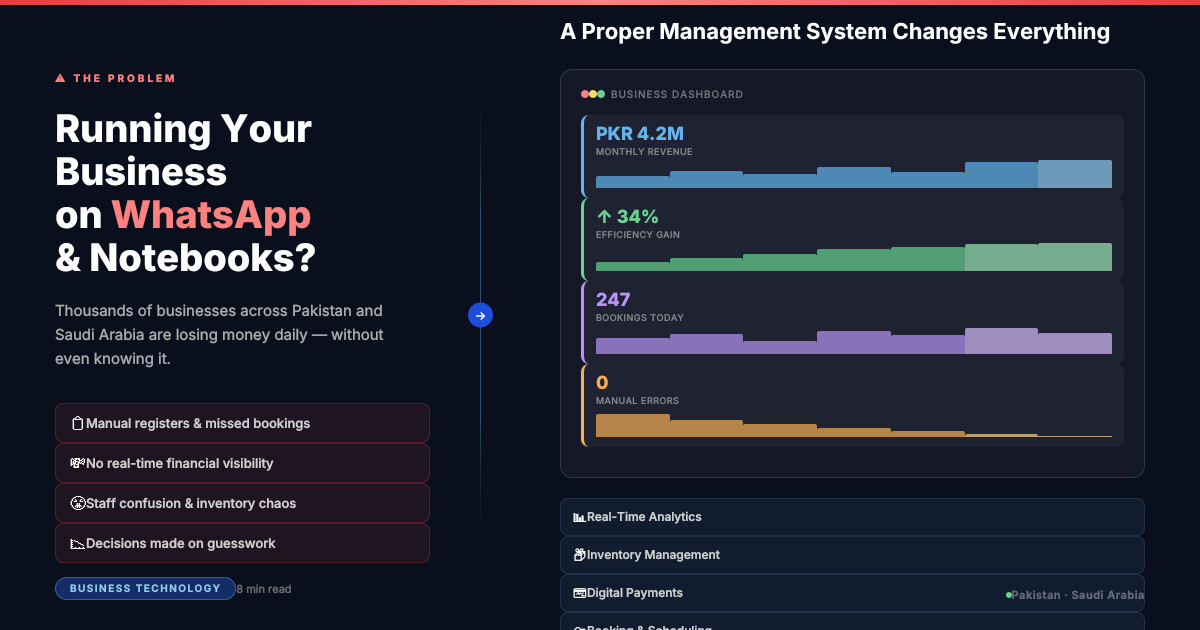
Month one: The owner can see, for the first time, the full picture — total active customers, total outstanding dues, revenue for the month, expenses for the month, and which parts of the business are driving the most value.
Month three: Patterns become visible. Slow periods are identifiable in advance. High-value customers stand out. Inventory reorder points are clear. Staff coordination happens through the system instead of through the owner.
Year one: The business is making decisions based on 12 months of real data. Growth planning is grounded in what the numbers actually show — not what the owner remembers or estimates.
This is not a dramatic transformation. It is a gradual, compounding shift from a reactive business to a proactive one.
Industries Where This Gap Is Most Visible Right Now
Based on the pattern of businesses across Pakistan and Saudi Arabia making this transition, the industries where manual operations are causing the most measurable damage are:
Car rental and vehicle fleet businesses — booking conflicts, investor payment tracking, customer due management, and fleet status visibility are all difficult or impossible to manage manually at scale.
Banquet halls and event venues — booking management, inventory allocation per event, client payment schedules, and staff coordination all require integrated systems to run without costly errors.
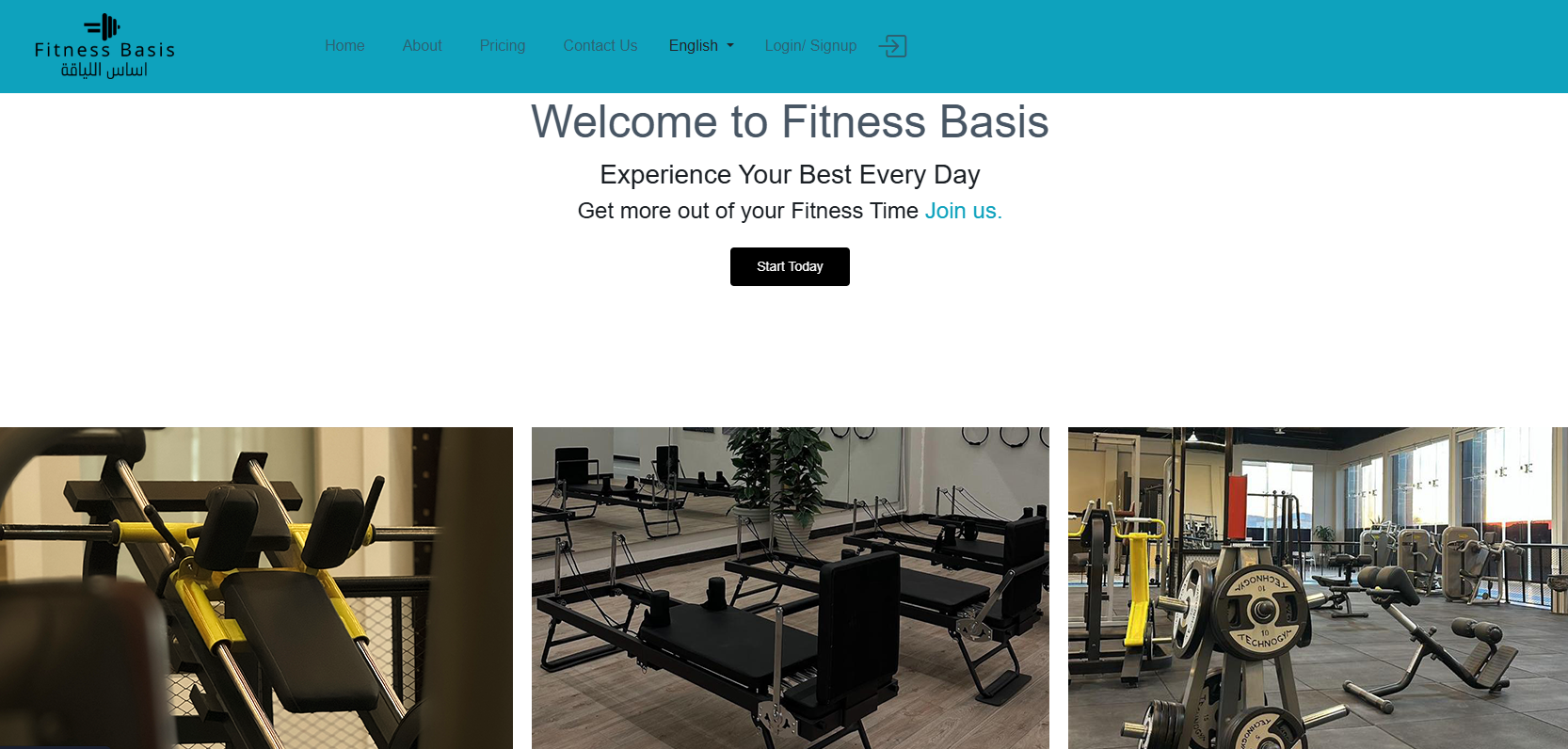
Gyms and fitness clubs — subscription management, renewal tracking, payment method variety, and member communication are all handled far more effectively by a dedicated system.
Retail and restaurant businesses — inventory management, sales tracking, supplier payments, and VAT compliance all require real-time data that manual systems cannot provide.
Service marketplaces — platforms connecting customers with service providers require digital infrastructure from day one to manage trust, payments, and transactions at any meaningful scale.
The Right Time to Switch
There is no perfect moment. Businesses that wait for the “right time” — when they are bigger, when things are less busy, when they have more budget — almost always wait longer than they should.
The right time to implement a management system is when the cost of not having one has become visible. For most businesses, that moment arrives earlier than expected — often within the first year of operation, sometimes in the first few months.
The businesses that move quickly tend to scale faster, make better decisions, retain more customers, and collect more of the money they are owed. The businesses that wait tend to find that the problems they hoped to eventually solve have grown more complex and more expensive to unwind.
Conclusion
The gap between a business that thrives and one that plateaus is rarely about effort. Business owners in Pakistan and Saudi Arabia are among the hardest-working people in any market. The gap is almost always about information — who has it, how quickly they can access it, and whether the business is structured to act on it.
A management system is not a luxury for large enterprises. It is the foundational infrastructure that allows any business — of any size, in any industry — to operate with the clarity that growth requires.
If you are still running your business from a notebook and a WhatsApp group, the question is not whether to make the switch. The question is how much longer the delay is going to cost you.